

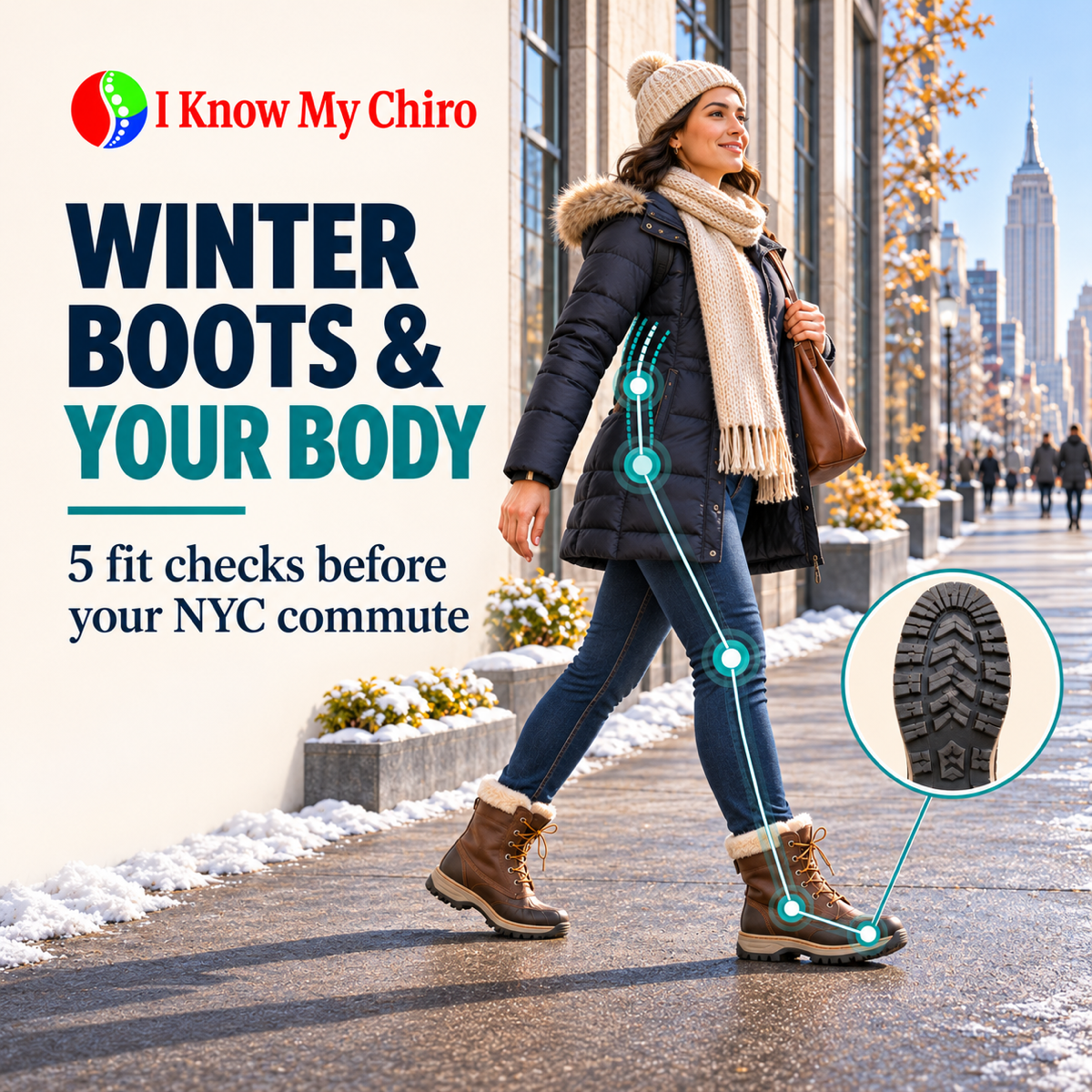
Winter Boots and Walking Mechanics: 5 Smart Fit Checks for NYC Commuters
Winter boots and walking mechanics are more closely connected than many New Yorkers realize. A boot that feels fine for a few minutes in a store may behave differently during a long commute, on subway stairs, or across a wet and uneven sidewalk. The wrong fit does not automatically cause an injury, but heel movement, limited ankle motion, toe pressure, extra weight, or worn tread can change how comfortable and steady each step feels.
Before winter weather arrives in full force, use these five practical checks to see whether your boots support a comfortable commute. They take only a few minutes and may help you notice a problem before a short walk becomes a long, uncomfortable day.
What You Will Learn
Why Winter Boots and Walking Mechanics Matter
Walking is a coordinated movement involving the feet, ankles, knees, hips, pelvis, and spine. Footwear sits between that system and the ground. Compared with lightweight everyday shoes, winter boots may have a higher shaft, a stiffer sole, deeper tread, more insulation, and additional weight. Those features can be useful in cold or slippery conditions, but they can also affect how freely the ankle moves and how the foot contacts the ground. A 2024 laboratory study comparing boots with casual footwear found measurable differences in some hip, knee, and ankle movements and forces. The study was small and included only healthy young men, so its results should not be applied to everyone. Still, it supports a sensible point: footwear design can influence walking mechanics. You can read the study in PubMed. The goal is not to find one “perfect” boot. Feet, walking patterns, work demands, and health histories differ. When considering winter boots and walking mechanics, the better goal is to find a pair that stays secure, allows a natural step, provides useful traction, and remains comfortable during the activities you actually perform.5 Smart Fit Checks for Winter Boots and Walking Mechanics
1. Check whether your heel stays secure
Put on the socks you normally wear and lace or fasten the boots as you would for a commute. Walk at a normal pace, then go up and down a few stairs if it is safe. A small amount of movement may occur, but repeated heel lifting can make the foot work harder to keep the boot in place. It may also lead you to shorten your step or grip with your toes. If the heel slips, first adjust the lacing rather than simply buying a smaller size. A smaller boot may create pressure at the toes while failing to solve a shape mismatch around the heel. Persistent rubbing, numbness, or a developing blister is a signal to stop and reassess the fit.2. Give your toes enough room
Insulated socks take up space. Stand fully upright so your weight settles into both feet, then gently move your toes. They should not be crushed together or repeatedly strike the front of the boot when you walk downhill. Toe room is an important part of checking winter boots and walking mechanics, especially for people with bunions, hammertoes, circulation concerns, or reduced sensation. More room is not always better. An excessively large toe box can allow the foot to slide, particularly when stopping or descending stairs. Look for secure support through the midfoot with comfortable space in front of and around the toes.3. Inspect the tread and test traction cautiously
A boot can fit well and still be a poor choice for slick conditions. Traction is central to winter boots and walking mechanics. Look at the entire outsole. The tread should have visible channels and edges rather than smooth, hardened, or unevenly worn areas. Check both boots; one side may wear faster than the other. Research on winter footwear shows that outsole design and material influence slip resistance, while performance can vary across wet and icy surfaces. Studies evaluating winter footwear are available through PubMed. No sole makes ice risk-free, so good tread should be combined with slower steps, attention to surface changes, and handrail use when available. The CDC/NIOSH guidance on slips, trips, and falls also emphasizes recognizing hazards and using appropriate footwear.4. Notice whether the boot limits ankle movement
A high boot may feel supportive, but a very stiff shaft can restrict the ankle. Walk several lengths of a room and pay attention to whether you can roll smoothly from heel toward toe. If your steps become unusually short, your feet turn outward, or your knees and hips feel as though they are compensating, the boot may not match your needs. New boots sometimes soften slightly with use, but painful pressure should not be treated as a normal break-in requirement. When comparing winter boots and walking mechanics, comfort during natural movement matters more than how supportive a boot looks.5. Perform a real-life comfort test
Do not make the first long wear a full workday. Try the boots indoors on a clean surface, then progress to a short neighborhood walk if the store’s return policy allows it. Include turns, a gentle incline, and a few steps. Afterward, check for hot spots, rubbing, tingling, unusual fatigue, or discomfort that continues after the boots come off. Also compare the wear pattern on an older pair. Heavy wear on one edge does not diagnose a condition, but it may offer useful information to discuss with a qualified clinician—especially when it appears alongside recurring foot, ankle, knee, hip, or lower-back symptoms.Practical Tips for a Safer NYC Winter Commute
Even a well-fitting boot cannot remove every winter hazard. After reviewing winter boots and walking mechanics, use these habits to make cold-weather walking more manageable:- Shorten your stride on uncertain surfaces. Smaller, deliberate steps can help keep your center of mass over your base of support.
- Leave extra time. Rushing increases the temptation to take long steps, cut across icy patches, or skip a handrail.
- Keep your hands available. When possible, use a backpack or cross-body bag instead of carrying multiple items.
- Watch transitions. Entrances, subway stairs, curb cuts, metal grates, and patches near melting snow can change from dry to slippery quickly.
- Dry your soles. Packed snow and debris can reduce contact between the tread and the ground.
- Replace worn footwear. Deep tread is not permanent. Inspect your boots throughout the season.
When Foot or Joint Discomfort Deserves an Evaluation
Temporary muscle fatigue after an unusually long walk can occur, especially at the beginning of a season. Symptoms should not, however, be ignored when they are severe, persistent, worsening, or repeatedly linked with walking. Consider an evaluation if you notice recurring foot or ankle pain, swelling, numbness, tingling, weakness, a new limp, or pain that moves into the knee, hip, or back. Seek urgent medical care after a fall if you cannot bear weight, see a deformity, experience severe swelling, have an open wound, or develop other concerning symptoms. Chiropractic care is not a substitute for emergency evaluation. At I Know My Chiro, an appointment may include a history and movement assessment involving the feet, ankles, knees, hips, and spine. When appropriate, care recommendations may include manual therapy, mobility work, home exercises, footwear considerations, or referral to another provider. Treatment depends on the examination; no single approach is right for everyone, and results cannot be guaranteed. Learn more about our approach to foot pain and lower-extremity discomfort. If winter boots seem to be revealing a recurring problem, request an appointment at our Midtown Manhattan office.Frequently Asked Questions
Can heavy winter boots cause back pain?
Boot weight alone does not prove the cause of back pain. However, a heavy, stiff, loose, or uncomfortable boot may change the way some people walk. If back discomfort repeatedly appears with a particular pair and improves when you change footwear, that pattern is worth discussing during an evaluation.Should winter boots feel tight at first?
They should feel secure, not painful. Insulation may settle and some materials may soften, but numbness, pinching, rubbing, or toe pressure should not be accepted as a necessary break-in period.Are high-top boots always better for ankle support?
No. A higher shaft can change how a boot feels around the ankle, but height alone does not guarantee stability or prevent injury. Fit, sole construction, lacing, traction, comfort, and individual needs all matter.How often should I replace winter boots?
There is no universal schedule. Replace or repair them when the tread is worn smooth, the outsole separates, the upper no longer holds the foot securely, waterproofing fails, or the pair causes persistent discomfort. Frequent walkers may need to inspect footwear more often.What socks should I wear when checking boot fit?
Use the same thickness and style you expect to wear most often. Testing a boot with a thin dress sock can produce a misleading fit if you later commute in a thick winter sock.Take the Five-Minute Boot Check
Winter boots and walking mechanics deserve attention before the first icy commute. Check heel security, toe space, tread, ankle movement, and real-life comfort. A few intentional minutes now can help you choose footwear that feels steadier and more comfortable during a New York winter. If discomfort persists despite a reasonable footwear change, do not rely on guesswork. A focused evaluation can help identify whether the issue is coming from the boot, the foot and ankle, another joint, or a combination of factors. This article is for general educational purposes and is not medical advice or a diagnosis. Seek individualized guidance from a qualified healthcare professional. If you have severe symptoms or a possible emergency, obtain urgent medical care.

Tags
Back Pain
Chiropractic Care
Chiropractor
Chiropractor Manhattan
Chiropractor Near Me
Headaches
Health
IKMC
I Know My Chiro
Lower Back Pain
Manhattan Chiropractor
Massage Therapy
Midtown Manhattan
Mobility
Muscle Tension
Neck Pain
NYC Chiropractor
Pain Relief
Physical Therapy
PiezoWave2 Therapy
Posture
Shoulder Pain
Spinal Adjustment
Spinal Health
Wellness